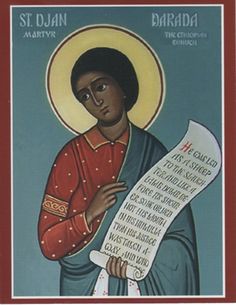
Perhaps you’ve read or heard of the story in Acts 8:26-39. Deacon Philip was guided by the Holy Spirit to run alongside a chariot where an Ethiopian Eunuch, an official to the queen, was reading an Old Testament scripture. He asked Philip to join and explain the meaning to him. Philip used the opportunity to teach him about the Gospel of Jesus Christ. The official believed Jesus to be the Son of God, was baptized, and went on his way rejoicing. Is there anything about this story so significant that we should know him as more than a high ranking eunuch from ancient Africa?
Let’s begin with the obvious fact that Djan Darada is undeniably black African. To be ‘Ethiopian’ (burned faced) in the Greco-Roman world meant that one was dark complexioned. We traditionally accept the story that he descended from the ancient Ethiopians who converted to Judaism at the time of the Queen of Sheba’s meeting with King Solomon (III Kingdoms/I Kings 10:1-13). Modern Ethiopia’s Beta Israel community still exist to this day. We can also point to the scripture in Acts that the Queen of Ethiopia was called the ‘Candace’ or ‘Kandake’ (probably not ‘Candice’) which was a term used for a female ruler of a Nubian kingdom. Unlike Egypt, the Nubians successfully resisted the Romans and had diplomatic and trade relations with other ancient lands. Cushites (an older term for Nubians) were likely among the mixed multitude in Exodus 12:38 an assumed to be present at Pentecost (Acts 2). Either way, Djan Darada was a dark complexioned African man.
He was a man of chastity. In ancient societies, men were castrated to become eunuchs so they could be trusted to guard harems and noble women. Perhaps Djan Darada was forced to undergo this as a slave. He may have had it done willingly for the benefits and honors of serving the Queen. Having the trust of women in the highest and lowest segments of society is something worthy of emulating even in our modern world. Maybe not by castration. But committing ourselves to purity before marriage and being faithful to our spouses.

I am led to believe that Djan Darada chose to be a eunuch as the Lord said in Matthew 19:11-12, for the kingdom of heaven’s sake. Considering he was returning from Jerusalem to worship, reading the scriptures, and an angel of the Lord sent Phillip to meet him. As this African went on a pilgrimage and applied himself to practice and study the faith, God revealed even greater things to him. If we are to be so blessed, we must go beyond our familiar places. Attending services and reading from the holy ones must become a part of who we are no matter how high we rise in society.
Djan Darada was reading Isaiah 53:7-8. These words about a man as a lamb being taken to the slaughter without saying a ‘mumbling word’ and being humiliated with justice denied to him was a foretelling of the trial and crucifixion of Christ. These words are read by the Orthodox priest as he prepares the holy bread for the Eucharist. And was not justice denied to our forefathers also? The man who Philip met on the road was no ordinary castrated royal official. This man was, no IS a saint who represents the best of who we can become in Jesus Christ. Let’s say his name; Saint Djan Darada!


 St. Djan Darada Fellowship
Leave a comment